Humanoids have bones, motors and brains. What they lack is everything in between: the sheaths, fluids and muscle that let a body run cool, slide without wear, and last. Kokodo designs that layer. It starts with lubrication and ends with muscle.
25–35%of peak torque is all an air-cooled humanoid joint can hold continuously1
3 × 10⁵cycles is today's passing line for a dexterous hand. Industry needs 10⁶ or more2
0–40 °Cis the rated window of standard strain-wave grease. Measured ankle joints reach 80–96 °C3,4
μ 0.001–0.02is how cartilage slides at 1–10 MPa. Dry polymer bearings sit at 0.07–0.295
Thesis
Robots are dry. Bodies are wet.
Every humanoid shipping today is built like a machine tool: a single grease fill sealed in for life, still air around hot windings, dry cords dragged over dry pins.
Biology solved the same problems the opposite way. Nothing in a body slides dry, nothing sheds heat through still air, and nothing is lubricated once and left alone: the hyaluronan in a joint is replaced roughly every day6. Fluid is infrastructure, shared by every tissue it touches.
Our thesis is that the next large gain in humanoid hardware comes from this layer, the one between the skeleton and the skin, more than from a better motor. The evidence on what limits today's robots points the same way: heat, lubricant life, tendon wear.
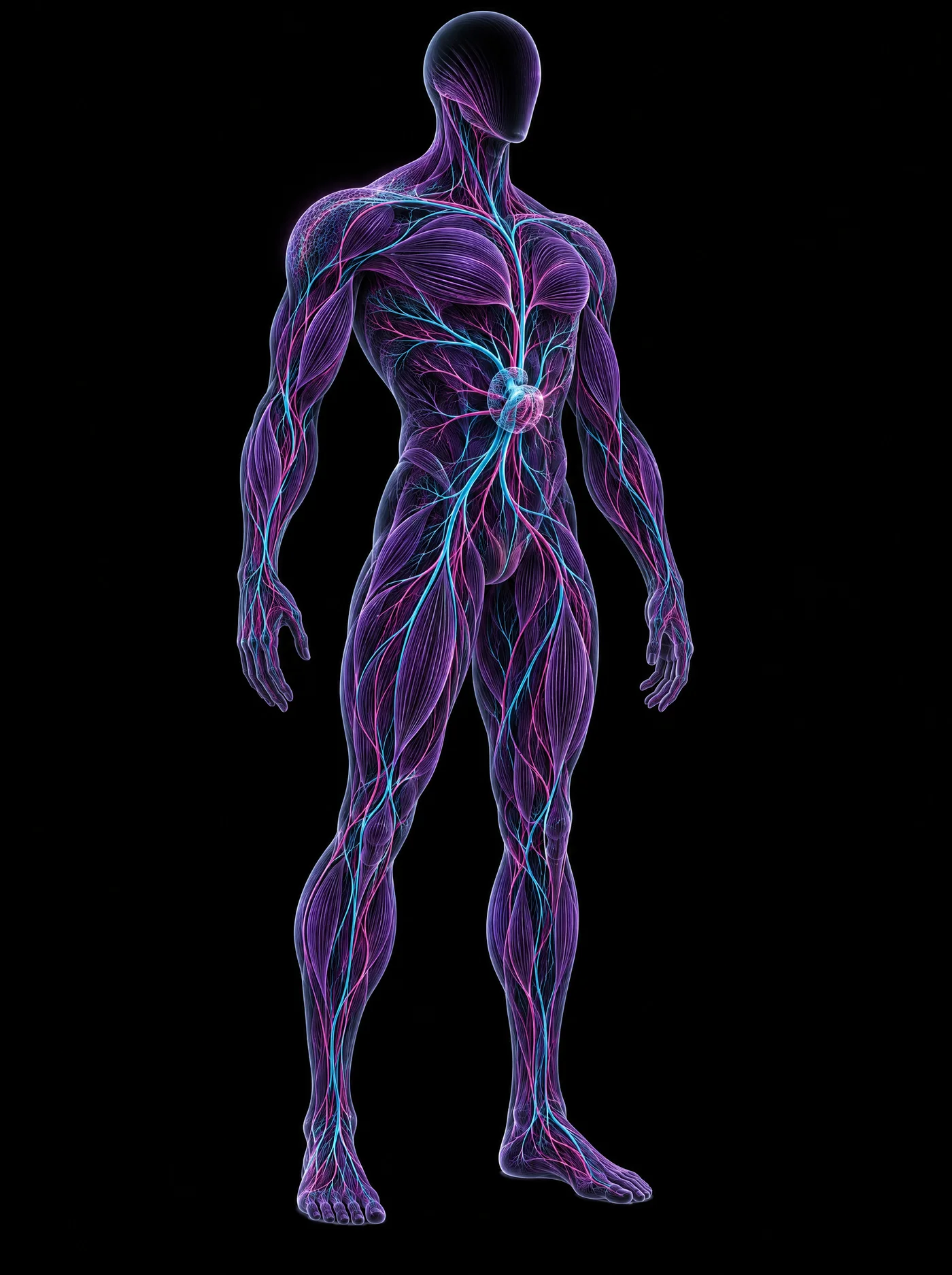
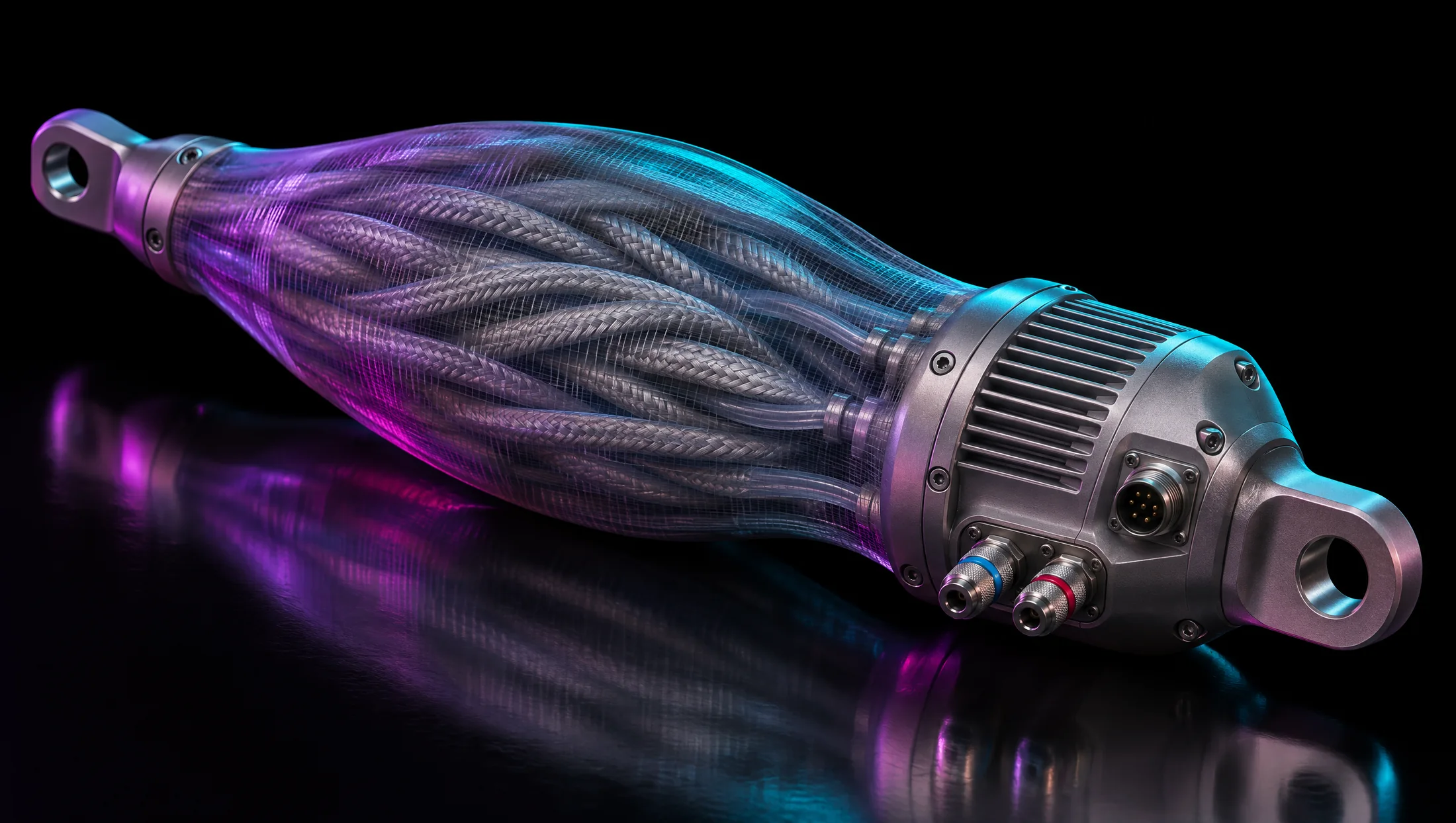
Concept visual. Muscle bundles with supply and return vessels threaded between them.
Principle 01
Copy functions, not anatomy
Twenty-five years of anatomically faithful musculoskeletal humanoids reached human-like range of motion, yet none walks robustly. Their own builders list the causes: modelling difficulty, damaging internal forces, heat, fraying wires7,8. What did transfer to working robots are functions: springs, cheap holding, low-ratio tendon drives, liquid cooling.
Principle 02
Two fluids, like the body
Synovial fluid stays local to each joint. Blood circulates. No published system makes one fluid do every job: the fluids that store energy are conductive electrolytes, and the ones that insulate and cool store nothing9. So Kokodo uses two: a local water-based boundary lubricant where things slide, and a circulating dielectric ester where things heat, mesh and push.
Principle 03
Earn the muscle
No artificial muscle is ready to be the primary actuator of a full-size humanoid today. We say so plainly. The layer is staged so that each step solves a problem makers already have, on hardware they already ship, and funds the next: diagnostics, then sheaths, then a wet loop, then muscle.
Evidence
Where humanoids break today
Robot joints already exceed human peak joint torque. The shortfall is in what a body does all day: sustain output, slide without wearing, absorb shock. These figures are published, not ours.
25–35%of peak torque, sustained
Heat sets the real torque rating
Air-cooled humanoid joints sustain about a quarter to a third of their peak torque; a representative quasi-direct-drive module is rated at 19 N·m/kg against a 45 N·m/kg peak1,10. Reported ankle actuators reach 80–96 °C, while standard strain-wave grease is specified for 0–40 °C ambient4,3. Only 6 of 21 robots finished the 2025 Beijing half-marathon; the 2026 winner was liquid-cooled11,12.
~11 Minput revolutions to efficiency collapse
The lubricant dies before the steel
Catalog life for a strain-wave gear is a bearing-fatigue number, 7,000 h at rated torque, and it assumes healthy grease13. In ESA life tests, run in thermal vacuum with space-grade lubricants, the lubricant went first: efficiency held at 80–90% for about 5 million input revolutions, then fell to 40% by about 11 million, with gear teeth still in good condition. Cold, the same gear ran at 10–20%14.
3 × 10⁵cycles, hand life today
Hands and forearms are the bottleneck
Tesla's chief executive calls the forearm and hand “more difficult than the entire rest of the robot”15, and durability after a month of use still gates external deliveries16. Figure named the forearm its top hardware failure point after 1,250 hours at BMW: three degrees of freedom, thermal limits and moving cables in one tight volume17. Vendor hands pass at about 300,000 cycles; the best public tendon endurance figure is about 400,0002,18.
−24%fingertip force lost in the sheath
Tendon friction is unmeasured and large
One recent hand lost about a quarter of its fingertip force (33 N to 25 N) across an extra 0.9 m of sheath19. Robot-hand papers almost never report a friction coefficient or cycles to failure. Maintenance guides describe wear where tendons cross pulleys and periodic re-tensioning20. Conventional wet lubricants barely help: silicone on a PTFE liner improved efficiency by 2%21.
88 N·mratcheting threshold, size-14 gear
Rigid transmissions do not like falls
A small strain-wave gear ratchets at 88 N·m, a load one bad fall can deliver13. Roller-screw life scales with the cube of load, so running a 26 kN-rated screw at 8 kN leaves roughly 170 km of travel22. Actuation is already 40–60% of the bill of materials23, and no maker publishes joint life or mean time between failures, while industrial buyers expect 99.99% reliability24.
The pattern to copy
Five jobs fluid does in a body
Muscle is a mediocre actuator on any single metric: about 0.35 MPa peak stress, 20% strain, 50–280 W/kg25. Its advantage is integration. Each of these jobs has a published mechanism, and machines implement almost none of them.
01
Bear
In cartilage, pressurised fluid inside a porous solid carries upward of 90% of the load at first contact26.
Robots today: steel on steel at gigapascal contact pressure.
02
Slide
A molecular boundary layer of lipids on hyaluronan, anchored by lubricin, gives μ 0.001–0.02; a tendon in its sheath runs at 0.02–0.035,27.
Robots today: dry liners, friction unreported.
03
Cool
Blood carries heat from working muscle to the skin, so output is limited by the whole body's surface, not by one hot spot.
Robots today: still air, 25–35% of peak torque.
04
Renew
Joint hyaluronan turns over with a half-life of about 21 hours. The lubricant is never old6.
Robots today: one grease fill for the life of the joint.
05
Sense
Spindles report length, tendon organs report force, and the tissue itself reports damage.
Robots today: lubricant health is not measured at all.
System architecture
Five layers between skeleton and skin
A forearm in cross-section. Each layer does one of biology's jobs with parts that exist today or have been shown in a lab. Select a layer to see what it is, what is published, and what is still a target.
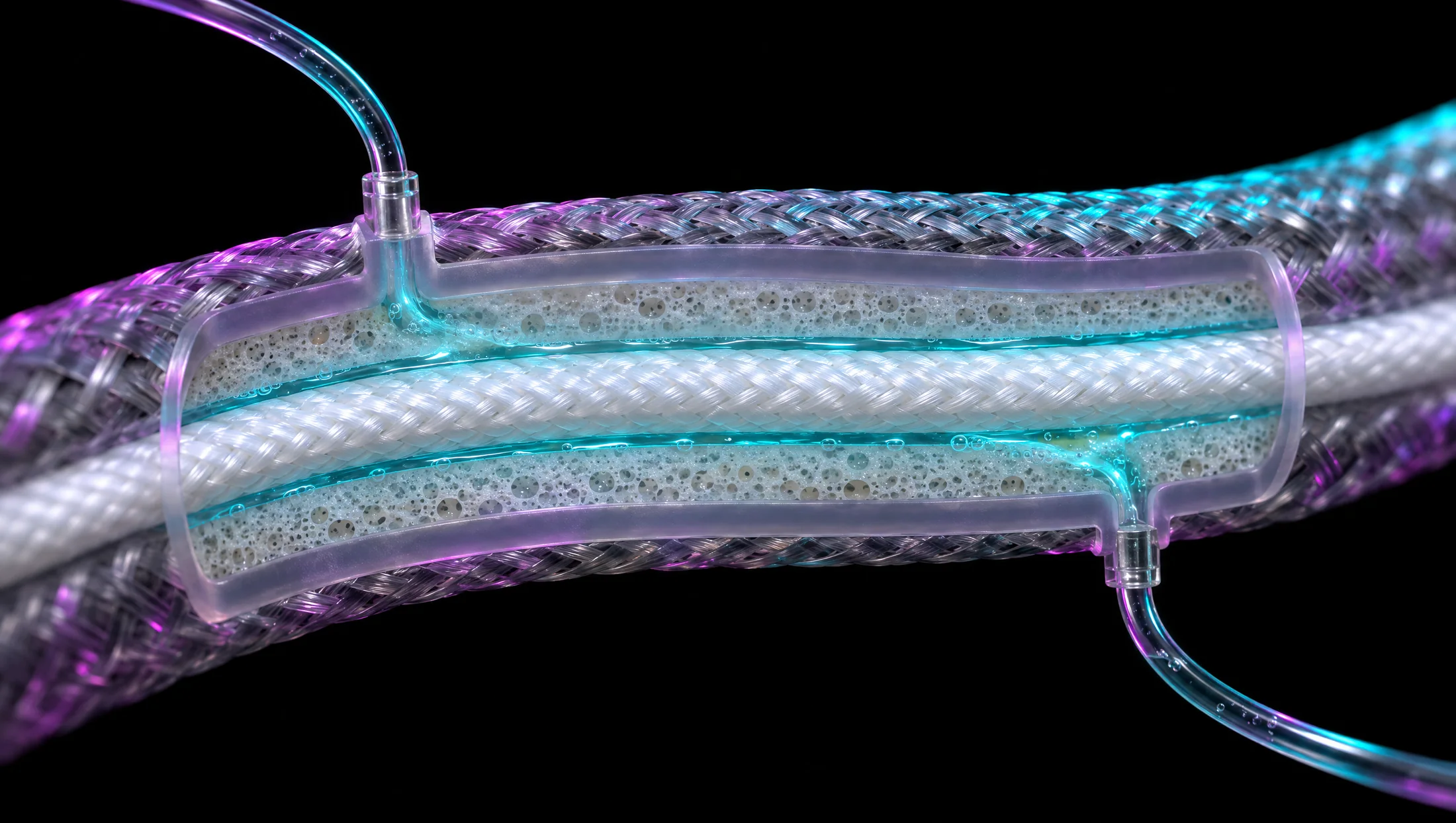
Every tendon and every sliding pad runs inside a small sealed sheath. The liner is a porous hydrogel that holds a glycerol–water fluid and feeds a surface-bound lubricant film as that film wears. Hard guide points are coated in diamond-like carbon. The fluid stays local, a few millilitres per sheath, and never circulates.
It is water-based on purpose. Hydration lubrication only works with water, and glycerol keeps it liquid, non-volatile and non-toxic. This layer is for conformal, low-pressure contacts. It is not for gear teeth.
Biological analogue: blood, with a filter and a radiator
Vasa: one circulating ester
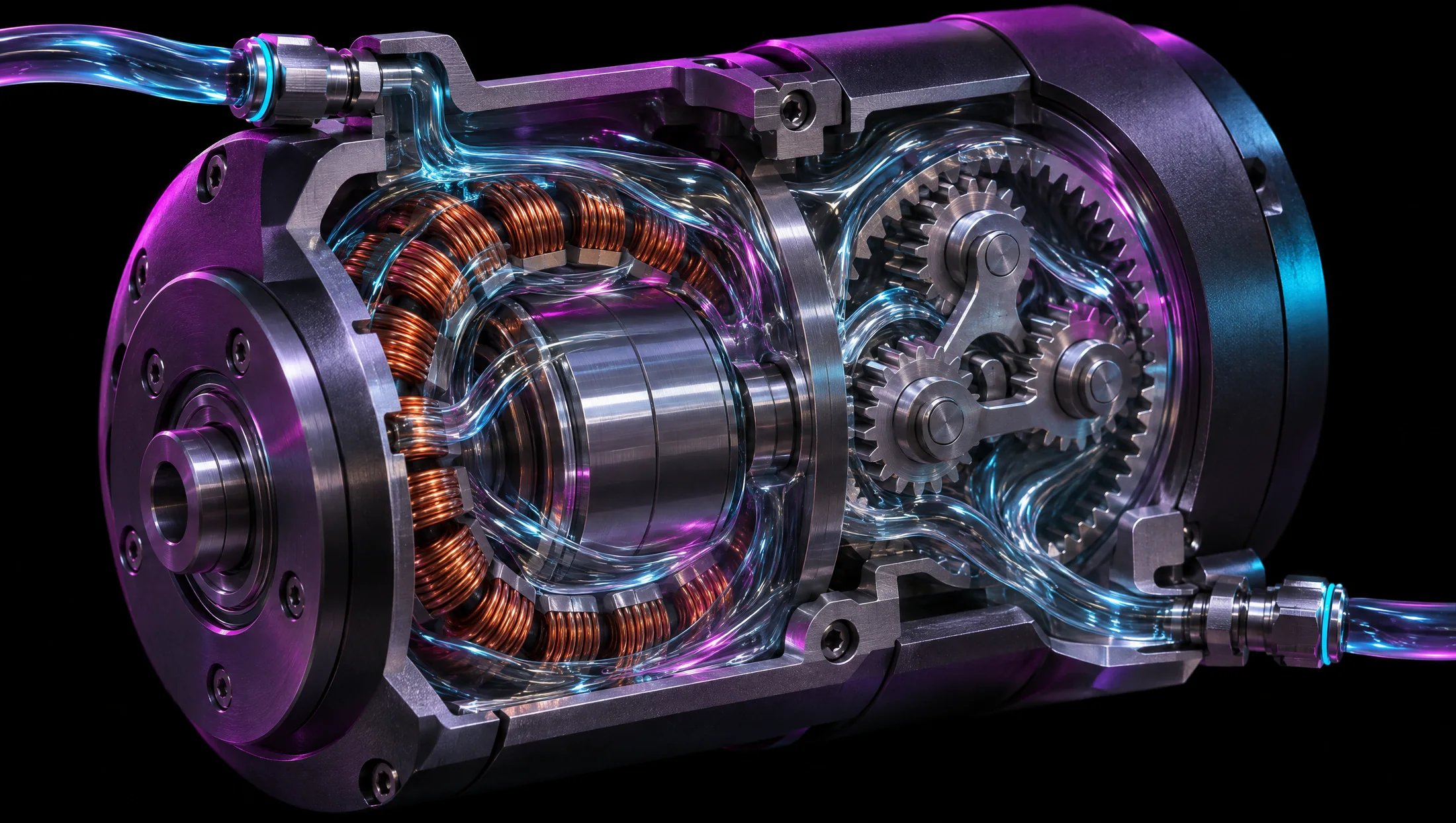
A single synthetic ester of the class used in transformers circulates through the hot and loaded parts: over motor windings to cool them directly, through gear stages and screws to lubricate them, past a filter and sensor node, and out to a heat exchanger under the back shell. Electric-vehicle drive units already cool and lubricate with one oil. We found no humanoid that does.
The ester is an electrical insulator, so motors can sit in it. Its fire point is above 300 °C and it is not classified as hazardous30. Fluorinated coolants are avoided: their main supplier has left the market and the substitutes are also PFAS31.
Cooling, published basis
Liquid or oil-immersed joints sustain 50–70% of peak against 25–30% in air (secondary data)1
Continuous torque, target
≥ 1.5× the same joint in air
Loop pump
Quiet mechanical micro-pump. Solid-state fibre pumps reach only 100 kPa per metre today32
Known weak point
Viscosity, about 29 mm²/s at 40 °C; a thinner blend is open work
Biological analogue: muscle fascicle and its motor unit
Myon: electro-hydrostatic fibre muscle
A brushless motor, cooled by the Vasa loop, turns a small reversible pump that moves fluid between two opposing bundles of braided fibres. Pressure makes a fibre swell and shorten, which pulls a tendon. The motor stays, because nothing converts electricity to work better. What changes is the transmission: fluid and fibre in place of gear teeth.
There are no servo valves, which waste about 43% of input power as throttling in conventional hydraulics, and hydraulic braided muscles have been measured at 80% transduction against 27% for air33. Pump-per-actuator units are back-drivable34.
Working pressure
3–7 MPa (target)
Force per 8 mm fibre at 5 MPa
≈ 1.6 kN blocked (model, 20% derated)
Electrical-to-mechanical
≥ 55% target (0.9 motor × 0.8 pump × 0.8 fibre)
Readiness
Unbuilt. A research programme with exit gates
Biological analogue: the catch state of molluscan muscle
Catch: holding without paying
A motor holding a load burns power as heat for as long as it holds. Catch removes that cost two ways. A bistable valve can trap fluid in a Myon pair so the posture stays with the motor off. Thin electroadhesive films can lock a tendon in parallel, holding 20–31 N per square centimetre for one to two milliwatts per square centimetre35.
How much this matters was measured on a research leg driven by electrohydraulic muscles: holding a pose cost 9.4 mW, against 17 W for a matched motor-driven leg36.
Biological analogue: muscle spindle and Golgi tendon organ
Spindle: sensing, and the model
Fluid pressure reports muscle force. Pump revolutions report muscle length. Motor current against output torque, compared cold and warm, reports lubricant health. A debris and dielectric sensor in the Vasa loop reports wear before it becomes failure: iron in a lubricant rises slowly, then sharply37.
The layer ships with a validated simulator model. Makers train controllers in simulation and favour actuators a simple model can represent, so an actuator that cannot be simulated accurately will not be adopted, however good it is.
Biology reaches μ of about 0.001 at 1–10 MPa. A gear tooth or ball bearing runs near 1,000–3,000 MPa. One recipe cannot serve both, so the layer splits where the physics does.
The biological recipe has four parts a machine can copy: a compliant porous solid so that fluid carries the load, a surface-bound boundary layer for what solid contact remains, a reservoir of lubricant molecules in the bulk, and renewal. Three of the four now exist as synthetic materials.
Boundary layer. Polyzwitterionic brushes reach μ 0.0004 at 7.5 MPa in the lab and about 0.01 on real polyethylene parts; hip liners made this way are in clinical use39,28.
Self-renewing reservoir. Hydrogels loaded with trace lipids regrow their own boundary layer as it wears40.
Hard points. Diamond-like carbon against glycerol runs below μ 0.01 even in rolling and sliding contact, and is being engineered into slide bearings29,41.
Renewal by motion. Fascial gliding layers stiffen when they stop moving42. A sheath that pumps its own fluid with each stroke stays fresh for the same reason.
Why friction in the route matters
Capstan law, Tout/Tin = e−μφ. Our calculation. A finger tendon accumulates a full turn or more of wrap between forearm and fingertip. Taking friction from 0.10 to 0.02 lifts the tension that arrives from 53% to 88%, and cuts hysteresis and control delay with it.
High pressure: keep the oil young
In gear meshes, screws and bearings the answer is conventional chemistry, handled the way a car handles it and a robot does not: circulate it, cool it, filter it, measure it. The Vasa ester does this. It trades the last few points of boundary friction for a lubricant that never ages in place.
Same fluid cools the windings. Lower transmission friction and direct cooling relax the energy and thermal limits together.
Cold starts. The target is less than a 10-point efficiency spread between cold start and hot running; grease-packed gears can lose more than half14.
Debris leaves. Wear particles are carried to a filter instead of being ground back into the contact.
Interface
Contact pressure
Practice today
Kokodo layer
Published basis
Target
Tendon in sheath, tendon over guide
0.1–10 MPa
Dry PTFE liner or bare pin; 10⁴–4×10⁵ cycles shown publicly18
Friction below 0.01 between dry solids is real: 0.0035 across 2–80% humidity was shown in 2024, on a 3 mm contact at small loads43. We found no shipping superlubric bearing or gear. Dry solid-lubricated strain-wave gears built for space last about ten thousand output revolutions44, four orders of magnitude short of a walking robot's need. A coating is a reservoir that runs out. Kokodo's layer relies on liquids that are replenished.
The number that sets the bar
10⁸ load cycles per leg joint
A walking humanoid puts roughly 40,000 load cycles on each leg actuator per eight-hour shift1. Ten years of single shifts is about 1.2 × 10⁸ cycles, by our arithmetic. Public endurance data for hands sits two to four orders of magnitude below what years of use require. Either the layer lasts that long, or it is a cartridge that swaps in minutes. We design for both.
The muscle layer
Keep the motor. Replace the gears with fluid and fibre.
The honest state of the field: electrostatic and thermal artificial muscles are not ready to carry a full-size humanoid. The brushless motor is not the weak part of today's actuators. Its transmission is. Myon changes only that.
How a Myon pair works
One motor, one pump, two bundles. The pump moves fluid from the flexor bundle to the extensor bundle and back. Pressure difference sets torque.
Common pressure sets stiffness. Raising pressure in both bundles together stiffens the joint without moving it, the way co-contraction does.
Fibres are passive and light. Braid, liner and fluid sit on the limb. The motor and pump sit near the trunk. Less mass at the end of the limb means less energy per swing and a softer collision.
Pressure is a fuse. A relief path caps force in a fall. There is no tooth to skip.
Heat leaves with the fluid. The motor is immersed in the same ester that the Vasa loop carries to the radiator.
Clone Robotics is the best-known attempt at fluid muscle for a full body. Its figures remain company claims and its prototype has not been shown walking45. Myon differs in three ways: pump control with no valve per muscle, a lubricating dielectric fluid in place of water, and drop-in modules for conventional robots in place of a full anatomical copy.
Concept animation. A seven-fibre fascicle contracting; the braid angle opens as each fibre swells.
Size a fascicle
The ideal braided-muscle model: force falls from its blocked value to zero at free contraction, set by pressure, fibre diameter and braid angle. The bright curve applies a 20% knock-down for friction and end fittings. The dashed curve is the ideal. These are model outputs, not measurements.
Model · design target
blocked force
free contraction · stroke
work per stroke
joint torque at start of stroke
F(ε) = N · P · (πD²/4) · [3(1−ε)²/tan²θ − 1/sin²θ]. Skeletal muscle reference: 0.35 MPa peak stress over the same resting cross-section25. Thin pneumatic bundles reach about 0.30 MPa and 25–30% contraction in published tests46; the gain here comes from pressure. Free contraction is the model's upper bound; we design to a 25% working stroke.
Recruitment is a gearbox
A body grades force by recruiting more motor units. A Myon bundle is split into three fascicles sized 1 : 2 : 4 behind slow, bistable valves. Pressurising fewer fibres needs less fluid per millimetre of stroke, so the same pump flow moves the joint faster at lower force. Seven ratios, selected in software, let one motor sit near its efficient point for both a fast leg swing and a heavy stance. Variable recruitment was proposed for exactly this purpose in the fluid-muscle literature33.
Switch fascicles on and off to see the trade. Idealised, loss-free.
Four rungs. Each one fits a robot that exists today.
A new actuation supplier is adopted when it arrives as a sealed module with a catalogue of sizes, a reference design and a simulator model. So the layer is staged from zero new hardware upward, and the first rungs go where makers say it hurts: hands, forearms, heat.
RUNG 0 · SOFTWAREBuildable now
Pulse
A lubricant-health estimate for every joint, from signals the robot already has: efficiency from motor current against output torque, stiffness near zero crossing, and the spread between cold and warm running. In life tests, warm and cold efficiency converge as a lubricant dies14. No new parts.
Fits
Any geared joint with current and torque or position sensing
Gives the maker
A service flag before failure, and fleet wear data no one publishes
Gives Kokodo
The duty spectra every later rung is designed against
RUNG 1 · HANDS AND FOREARMSFirst hardware
Synovia Sheath
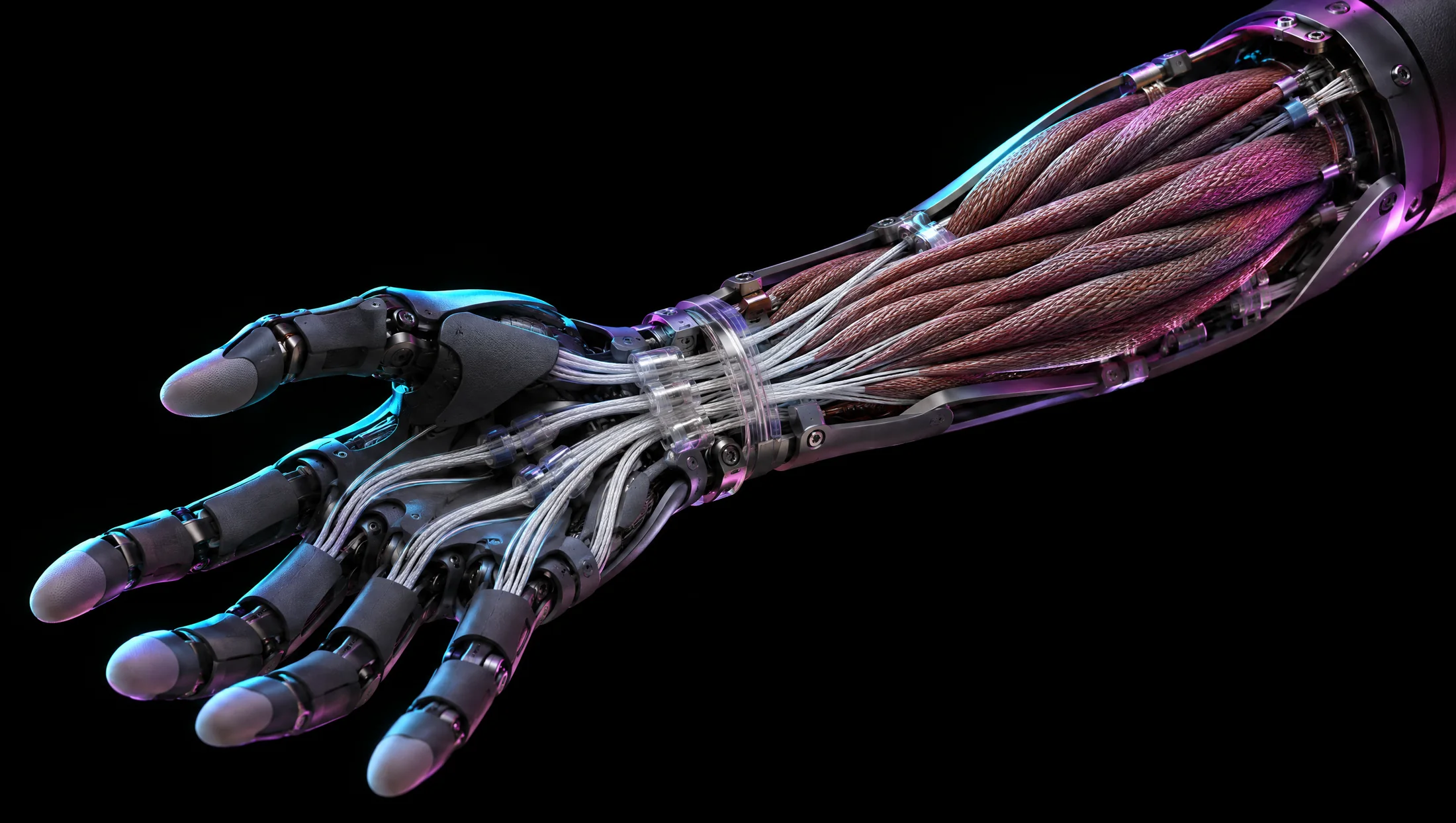
Drop-in lubricated conduits and guide inserts for tendon-driven hands and wrists. Same routing, same tendon, same motor. The sheath is the consumable that today's hands lack, built to last and to swap. Hands are also in short supply: about 70,000 units of demand against fewer than 20,000 built52.
Fits
Tendon hands with forearm actuators, the layout Tesla and 1X use53
Target
μ ≤ 0.02, ≥ 10⁷ cycles, swap in minutes
Proof needed
Ten-million-cycle rig data at finger bend radii
RUNG 2 · THERMAL AND GEAR LIFEWet loop
Vasa Capsule
A sealed jacket and loop that floods an existing actuator, or a whole forearm of them, with circulating ester. Liquid cooling of joints went mainstream in 2025–202654; using the same fluid to lubricate, filter and report wear is the step no one has shipped. Start with the forearm, where twenty-odd actuators share one hot, crowded volume.
Fits
Rotary joint modules and linear screw actuators, by size class
Target
≥ 1.5× continuous torque, outer surfaces under 55 °C55
Proof needed
Seal and elastomer life in ester; leak rate per year
RUNG 3 · ACTUATIONResearch programme
Myon Cartridge
A sealed, power-by-wire muscle module with the mounting points of the linear actuator it replaces: clevis to clevis, one connector, two coolant ports. Aircraft made hydraulics maintainable the same way, as self-contained units with no shared high-pressure plumbing. First sizes target the calf and the forearm, where low limb mass matters most.
Fits
Linear-actuator bays at ankle, knee and forearm
Target
25% stroke, ≥ 55% efficiency, < 1 W hold, home-quiet (1X claims 22 dB for NEO56)
Proof needed
Fibre fatigue life, pump noise, and a simulator model that transfers
The market it lands in
About 13,300 humanoids shipped in 202557. One bank's revised forecast is 890,000 a year by 203058. Forecasts differ several-fold, and all of them are forecasts.
Why makers would care
Safe contact in homes is a hardware problem, in the words of 1X's founder59. Low-inertia, back-drivable, cool-running limbs are the hardware answer.
The standards gap
No ratified standard covers a home humanoid with internal fluids. ISO 25785-1 is still a committee draft; home use falls back on ISO 13482 and UL 330060,61. We design to the stricter reading and publish our test data.
Open problems
What could prove us wrong
An architecture is a set of bets. These are the ones we think are most likely to fail, and the test that settles each.
Concept visual. Opposing polymer brushes and the fluid layer between them.
01
Risk
Water-based films on polymer tendons
Cartilage-class friction has only been shown in water, at low speed, mostly at small scale. A lubricated cable housing has shown low kinetic but high static friction.
Test
Tribometer, then a 10⁷-cycle tendon rig at finger bend radii, tracking static and kinetic friction, creep and fray. Stop if μ exceeds 0.05 after 10⁶ cycles.
02
Risk
Ester viscosity and seal compatibility
Transformer-class esters are thicker than ideal for small passages and cold starts, esters swell some elastomers, and no published source evaluates one as a gear and bearing lubricant.
Test
Four-ball and gear-rig wear tests against the grease it replaces; blend screening for viscosity, lubricity and breakdown strength; 5,000-hour soak of every seal and liner material at 100 °C.
03
Risk
Leaks, in a home
Hydraulic humanoids earned a reputation for leaks. A fluid layer has to be boring to live with.
Test
Sealed replaceable units, millilitre volumes in Synovia, low pressure in Vasa, a non-hazardous fluid, and leak detection by pressure decay. Publish leak rate per year.
04
Risk
Muscle hysteresis against simulation
Anatomical muscle robots failed largely on modelling. Learned controllers break outside their training conditions.
Test
System identification on a single-joint rig; ship the fitted model. If a simple model cannot track it, Myon stays in distal joints until it can.
05
Risk
Fibre fatigue life
Published cycle-life data for hydraulic braided muscles at these pressures is thin.
Test
Fatigue rigs at 3, 5 and 7 MPa to 10⁷ strokes. Design the fascicle as a cartridge either way.
06
Risk
Pump noise
A motor-pump per joint multiplies noise sources. Home robots are being sold on quietness.
Test
Acoustic measurement of candidate pump types at duty; choose pulsation-free geometries; fluid and sleeve as damping.
07
Risk
Efficiency below a good gearbox
A motor, pump and fibre chain at 55–60% does not beat a warm reducer at its best point.
Test
Compare over a full task, with holding, cold starts and cooling power counted. If the task-level number loses, Myon is not the product; Synovia and Vasa still are.
08
Risk
Clutch wear, and no standard to certify against
Film-clutch wear life is essentially unpublished, and no ratified standard covers fluid-filled home humanoids.
Test
Clutch cycling to failure on our own rig; engage with the ISO and UL working groups early, with data.
Proposed roadmap
From a tribometer to a calf
A proposed sequence, with a gate at the end of each phase. Nothing here has been built yet.
PHASE 0 · MONTHS 0–6
Measure
Pulse estimator on off-the-shelf joint modules
Tendon friction and wear rig
Fluid and seal screening
Gate: a friction and life dataset nobody else has published.
PHASE 1 · MONTHS 6–18
Sheath
Synovia inserts for one open tendon hand
10⁷-cycle endurance
Two pilots with hand makers
Gate: ten times the tendon life of the baseline, on a customer's hand.
PHASE 2 · MONTHS 12–30
Wet forearm
Vasa loop around a production forearm
Continuous-torque and leak data
Filter and sensor node
Gate: 1.5× continuous output with zero external leaks over 2,000 hours.
PHASE 3 · MONTHS 24–48
Muscle
Single-joint Myon rig, then a calf cartridge
Validated simulator model
Catch valve and film trials
Gate: task-level efficiency and noise that match a geared ankle.
Frontier tracks we are watching, not building yet
Electrostatic fast fibres
Electrohydraulic muscles already use vegetable-ester transformer fluid as both insulator and working fluid62. They could share the Vasa ester for fingers and faces, once drive voltage and force improve.
Silent solid-state pumps
Fibre pumps have no moving parts and make no sound, at 15 W/kg today32. Too weak for muscle. Possibly enough for a slow Vasa trickle at night.
Printed fascicles
Vision-controlled jetting prints soft and rigid materials together at 33 mL per minute63. A route to fibres, liners and manifolds made as one part.
Structural superlubricity
Humidity-tolerant since 2024, still at millimetre contacts and small loads43. A candidate for small pivots in the 2030s.
Self-renewing liners
Lipid-reservoir hydrogels are the first synthetic material to copy biology's renewal without living cells40. Durability past a million cycles is unknown.
Energy in the fluid
Redox “robot blood” stores about 11 Ah per litre today, and most of its motor power went to viscous loss9. Interesting. Not a third fluid we would add yet.
Sources
63 sources behind this page
Figures marked as targets are Kokodo design goals, not measurements. Several industry figures come through secondary aggregators that name their primary sources; those are labelled. The full research report carries the complete evidence base, including what could not be verified.
humanoid.guide — Peak vs continuous torque: air-cooled joints sustain 25–30% of peak; share by cooling method; ~40,000 leg load cycles per 8 h shift (secondary source citing vendors). Source ↗
Dexterous hand survey, arXiv 2611.06724 — vendor claims of ~300k cycles sit near today’s passing line; industrial use needs million-cycle life. Source ↗
humanoid.guide — Reported Unitree G1 ankle actuator temperatures of 80–96 °C under aggressive control (secondary). Source ↗
Lin & Klein, arXiv 2311.02681 — Hydration lubrication review and friction benchmarks (cartilage μ ≈ 0.001–0.02 at 1–10 MPa). Source ↗
Hyaluronan turnover in synovial fluid (PMC3510334). Source ↗
Kawaharazuka, Okada & Inaba, arXiv 2602.08518 — Musculoskeletal humanoids at JSK: Kengoro, Musashi and lessons learned. Source ↗
TUM (ECCE / Myorobotics) — on control of anthropomimetic tendon-driven robots. Source ↗
Science Advances 2024 (PMC11601206) — Redox-flow “robot blood” jellyfish: ≈11 Ah/L, ~44 Wh in 4 L. Source ↗
humanoid.guide — Torque density: a representative QDD module at ≈45 N·m/kg peak vs ≈19 N·m/kg rated. Source ↗
VnExpress — 6 of 21 humanoids finished the first Beijing humanoid half-marathon (Apr 2025). Source ↗
Scientific American — Liquid-cooled humanoid wins the 2026 Beijing half-marathon; temperature control still named among the hardest problems. Source ↗
humanoid.guide — Joint failure explainer: strain-wave L10 7,000 h at rated torque, cube-law derating, 88 N·m ratcheting threshold on a size-14 unit (secondary, citing Harmonic Drive catalog). Source ↗
Roberts et al., ESMATS 2015 (ESA/ESTL) — The performance and life of fluid-lubricated Harmonic Drive gears. Source ↗
Teslarati — Musk: the forearm and hand are “more difficult than the entire rest of the robot”. Source ↗
Electrek (Oct 2026) — Tesla Q3 2026 call: Optimus external deliveries around end of 2027; hands and durability after a month of use still open. Source ↗
Humanoids Daily — Figure retires the F.02: 1,250+ runtime hours over 11 months at BMW; forearm named the top hardware failure point. Source ↗
Short-term outcomes of total hip arthroplasty with PMPC-grafted polyethylene liners (PMC8154771). Source ↗
Tribology Letters 2019 — Superlubricity of DLC with glycerol in a rolling/sliding contact. Source ↗
MIDEL 7131 synthetic ester — product data: fire point >300 °C, pour point −56 °C, ≈29 mm²/s at 40 °C. Source ↗
Data Center Dynamics — 3M’s exit from PFAS (Novec, Fluorinert) and its effect on two-phase cooling. Source ↗
Smith, Cacucciolo & Shea, Science 2023 — Fiber pumps for wearable fluidic systems (100 kPa per metre, ~55 mL/min, 15 W/kg). Source ↗
Cornell dissertation — Hydraulic vs pneumatic braided muscles (80% vs 27% transduction); 43% of servo-hydraulic input power lost to valve throttling; variable recruitment. Source ↗
Hydra electro-hydrostatic humanoid (University of Tokyo) — one pump per actuator, backdrivable. Source ↗